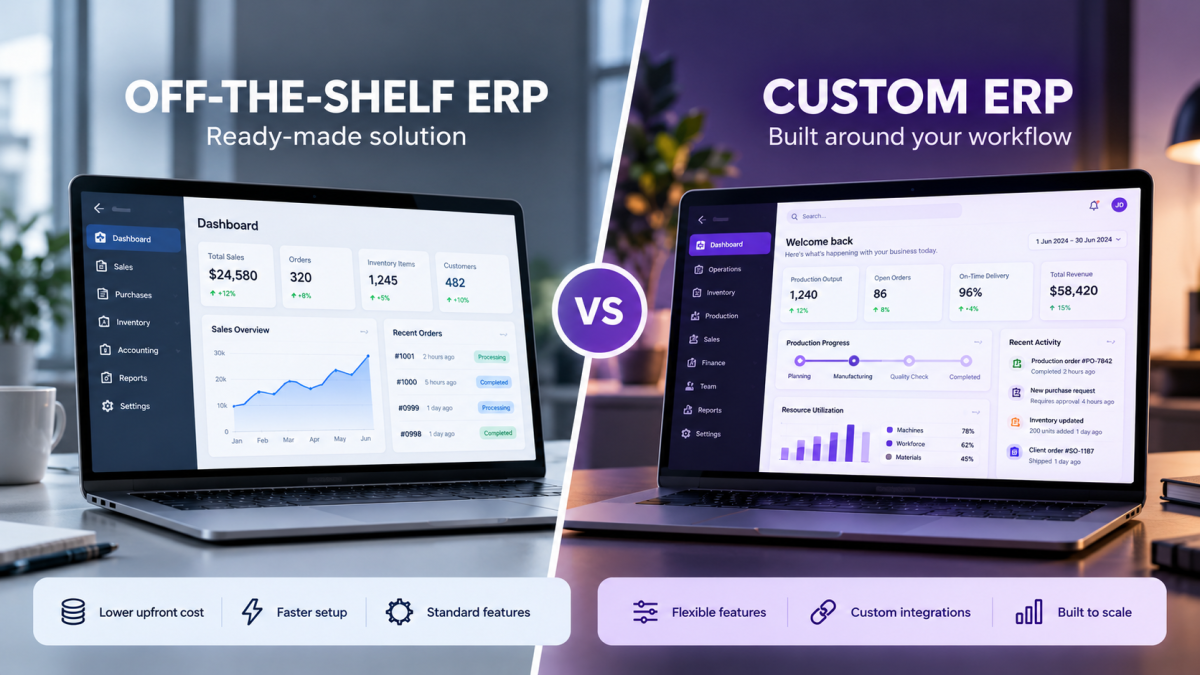
Choosing an ERP depends on your business processes, budget, and integration requirements. Off-the-shelf ERP offers ready-made functionality, while custom ERP is built around specific business needs.
What Is the Difference?
Off-the-shelf ERP provides existing modules for inventory, sales, purchasing, accounting, and reporting. It is generally quicker to implement and requires less initial investment.
Custom ERP is developed around your workflows, business rules, and integrations. It offers greater flexibility but requires more development, testing, and ongoing maintenance.
Custom ERP vs Off-the-Shelf ERP
| Factor | Off-the-Shelf ERP | Custom ERP |
|---|---|---|
| Initial cost | Generally lower | Generally higher |
| Implementation | Usually faster | Usually slower |
| Flexibility | Limited by product capabilities | Tailored to requirements |
| Integrations | Existing connectors and APIs | Built around specific needs |
| Maintenance | Often vendor-supported | Requires a maintenance plan |
| Best for | Standard business processes | Specialized workflows |
Actual costs and implementation times depend on the product, features, and project scope.
When Should You Choose Off-the-Shelf ERP?
Choose an existing ERP if you:
- Need standard inventory, sales, and accounting features.
- Want to launch quickly.
- Have a limited initial budget.
- Can adapt your workflows to the software.
- Need established vendor support and integrations.
When Should You Consider Custom ERP?
Consider custom ERP development if you:
- Have complex or industry-specific workflows.
- Rely heavily on spreadsheets and manual data transfers.
- Need specialized integrations or approval rules.
- Face rising costs from customization and workarounds.
- Require greater control over your software roadmap.
Custom development also brings responsibility for security, maintenance, backups, and future updates.
Is a Hybrid Approach Better?
For many businesses, the best option is to use an existing ERP for standard functions and build custom modules for specific requirements.
This avoids rebuilding features that already work while allowing you to address operational gaps.
How to Choose the Right ERP
Map your business processes, identify the main problems, compare existing ERP products, and estimate the total cost of ownership over three to five years.
Choose the solution that meets your requirements at an acceptable cost and risk—not simply the one with the most features.
How Icon Tech Studio Can Help
Icon Tech Studio develops custom software and integrations based on business requirements.
Not sure whether to buy or build? Contact Icon Tech Studio to discuss your workflows, budget, and ERP requirements.