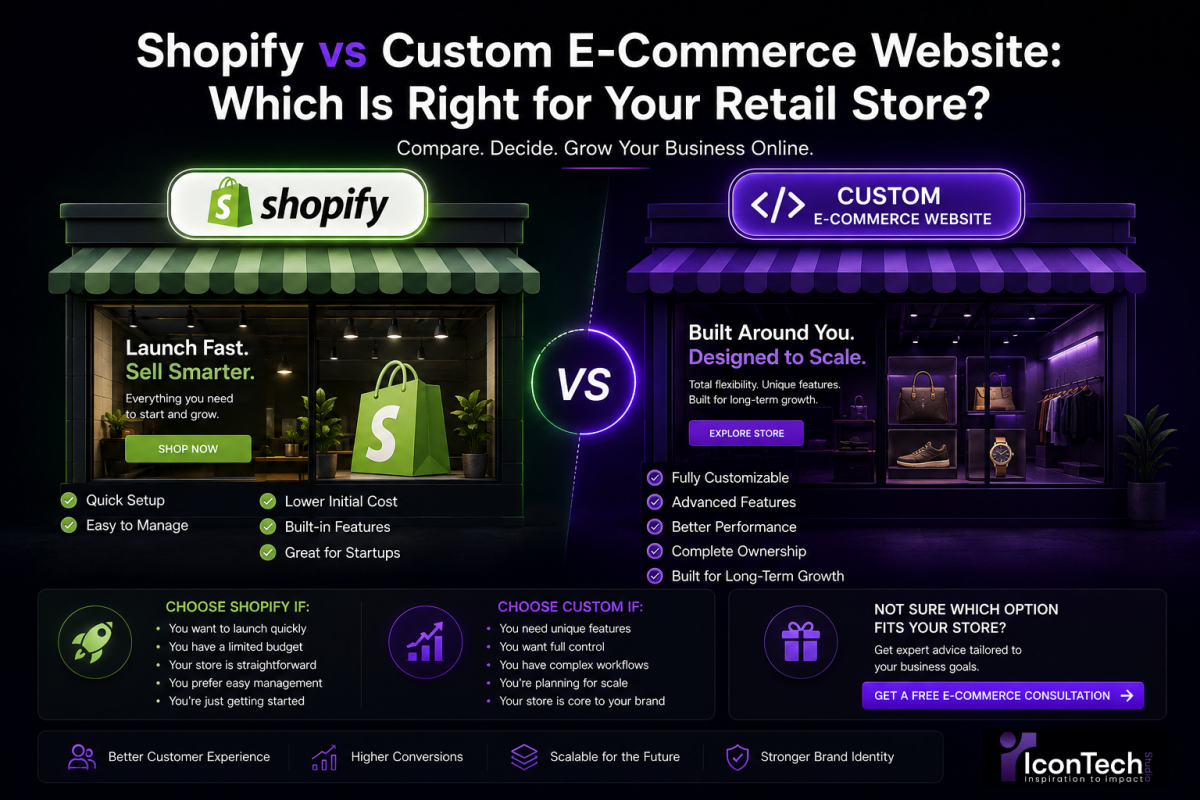
Shopify vs Custom E-Commerce Website: Which Is Right for Your Retail Store?
Meta Description: Comparing Shopify and custom-built e-commerce websites for retail businesses—cost, scalability, control, and long-term ROI explained in simple terms.
If you're planning to sell online in 2026, you've probably asked yourself one question:
"Should I build my store on Shopify, or should I invest in a custom e-commerce website?"
It's one of the biggest decisions retail business owners face.
And if you've spent even a few hours researching, you've likely found dozens of articles claiming one option is better than the other.
The truth?
There isn't a single "best" choice.
The right solution depends on your business, your goals, your budget, and where you see your brand in the next few years.
We've worked with businesses that thrive on Shopify because it gives them everything they need without unnecessary complexity.
We've also worked with businesses that quickly outgrew Shopify and needed a fully custom platform to support their growth.
So instead of asking,
"Which platform is better?"
Let's answer the more important question:
"Which option is better for your retail store?"
First, Let's Understand the Difference
Although both options allow you to sell products online, they work very differently.
Shopify#
Shopify is an all-in-one e-commerce platform.
It provides everything you need to launch an online store, including hosting, payment processing, inventory management, and themes.
Think of Shopify as moving into a fully furnished apartment.
Most of what you need is already there.
You simply move in, arrange the furniture, and start living.
Custom E-Commerce Website#
A custom-built e-commerce website is developed specifically for your business.
Every feature, page, workflow, and customer experience is designed around your requirements.
Think of it like building your own house.
It takes longer.
It costs more.
But everything is designed exactly the way you want it.
Shopify: The Advantages
For many small and medium-sized businesses, Shopify is an excellent starting point.
Faster Launch#
Most Shopify stores can be launched much faster than a custom website.
If you want to start selling quickly, Shopify has a clear advantage.
Lower Initial Investment#
Because much of the infrastructure already exists, development costs are generally lower.
This makes Shopify attractive for businesses launching their first online store.
Easy to Manage#
Adding products, updating prices, managing orders, and tracking inventory doesn't require technical knowledge.
Business owners can manage most daily tasks themselves.
Built-In Features#
Shopify includes:
- Secure checkout
- Payment gateways
- Product management
- Shipping tools
- Discount codes
- Basic analytics
- App marketplace
Many features are available without custom development.
Where Shopify Starts to Feel Limiting
Shopify is designed to work for millions of businesses.
Because of that, it isn't built specifically for yours.
As your business grows, you may begin to notice limitations.
For example:
- Limited customization in checkout (depending on your plan)
- Monthly subscription costs
- Transaction fees in certain situations
- Reliance on third-party apps
- Ongoing app subscription expenses
- Less flexibility for unique business workflows
If your business operates differently from a standard online store, Shopify may eventually become restrictive.
Why Businesses Choose a Custom E-Commerce Website
A custom website gives you complete freedom.
Instead of adapting your business to fit the platform, the platform is built around your business.
That's a huge advantage when your operations become more complex.
Unlimited Customization#
Need a unique product configurator?
A custom wholesale portal?
Advanced pricing rules?
Special customer dashboards?
Custom shipping logic?
No problem.
You're not limited by what a platform allows.
Better Performance#
A custom-built website contains only the features your business actually needs.
That often means:
- Faster loading times
- Better performance
- Cleaner code
- Improved SEO opportunities
Complete Ownership#
With a custom website, you own your platform.
You're not tied to a monthly subscription or restricted by platform limitations.
You have complete control over:
- Design
- Features
- Integrations
- User experience
- Future development
Easier to Scale#
As your business grows, your website can grow with it.
Need multiple warehouses?
A customer rewards system?
B2B ordering?
International pricing?
Marketplace functionality?
A custom solution can be built around your future plans rather than forcing you to work within predefined limits.
Think Beyond Today—Choose the Platform You'll Need Tomorrow
When comparing Shopify and a custom e-commerce website, it's easy to focus on what's best for your business today.
A better question is:
"Where do I want my business to be in the next three to five years?"
If you're just starting your online journey, launching products, and validating your market, simplicity and speed might be your biggest priorities.
But if you already have a growing customer base, expanding product lines, or unique business processes, you'll want a platform that can grow with you instead of holding you back.
Before making your decision, ask yourself:
- Will I be selling hundreds or thousands of products in the future?
- Do I plan to expand into new cities or countries?
- Will I need features that are unique to my business?
- Do I want complete control over my customer experience?
- Could my business model change over the next few years?
Your answers will often make the right choice much clearer.
The best e-commerce platform isn't the one with the longest feature list.
It's the one that supports your business today and gives you room to grow tomorrow.
Shopify vs Custom Website: Side-by-Side Comparison
| Feature | Shopify | Custom Website |
|---|---|---|
| Launch Speed | ⭐⭐⭐⭐⭐ | ⭐⭐⭐ |
| Initial Cost | Lower | Higher |
| Monthly Costs | Ongoing subscription | Mostly hosting & maintenance |
| Design Flexibility | Moderate | Unlimited |
| Custom Features | Limited | Fully Customizable |
| Scalability | Good | Excellent |
| SEO Flexibility | Good | Excellent |
| Performance Optimization | Good | Excellent |
| Ownership & Control | Platform-based | Complete ownership |

Which Option Is Right for Your Business?
Instead of focusing on features alone, think about where your business is today—and where you want it to be in the next three to five years.
Shopify Is a Great Choice If:#
✅ You're launching your first online store.
✅ You want to get to market quickly.
✅ Your product catalogue is relatively straightforward.
✅ You have a limited budget.
✅ You don't require complex custom functionality.
A Custom E-Commerce Website Is Better If:#
✅ Your business has unique workflows.
✅ You want complete control over design and functionality.
✅ You're planning for long-term growth.
✅ You need advanced integrations or automation.
✅ Your online store is becoming a core part of your business.
Don't Forget About Mobile Shoppers
More than half of online purchases now happen on mobile devices.
That means your online store needs to feel effortless on a smartphone.
Whether you choose Shopify or a custom solution, your website should be:
- Mobile-first
- Fast-loading
- Easy to navigate
- Simple to check out
- Optimized for every screen size
A beautiful desktop website means very little if customers struggle to buy from their phones.
Technology Matters More Than Ever
In 2026, customers expect online stores to be fast, secure, and easy to use.
At Icon Tech Studio, we build modern e-commerce solutions using technologies such as:
- Shopify for businesses that need a reliable, easy-to-manage platform.
- React for highly interactive storefronts.
- Tailwind CSS for responsive, high-performance user interfaces.
- Headless commerce architectures for businesses that need greater flexibility and speed.
- Secure backend technologies and APIs that allow your store to grow with your business.
Our goal isn't to push one platform over another—it's to recommend the solution that makes the most sense for your business.
One Mistake We See Too Often
Many businesses choose a platform based only on today's budget.
Six months later, they realise they need features the platform can't easily support.
Then they pay to rebuild everything.
On the other hand, some businesses invest heavily in a custom platform before they've even validated their products.
The smartest approach is finding the balance between what you need now and where you want your business to go.
Why Businesses Choose Icon Tech Studio
Every retail business is different.
That's why we don't believe in one-size-fits-all solutions.
Before recommending Shopify or a custom website, we take the time to understand:
- Your products
- Your customers
- Your daily operations
- Your growth plans
- Your budget
- Your long-term goals
From there, we recommend the platform that gives you the best return on your investment—not simply the one that costs the most.
Our e-commerce development services focus on:
✅ Conversion-focused store design
✅ Mobile-first shopping experiences
✅ Fast-loading, SEO-friendly websites
✅ Secure payment integration
✅ Scalable architecture
✅ Ongoing support as your business grows
Final Thoughts
Both Shopify and custom e-commerce websites are excellent solutions.
Neither is automatically better.
Shopify is ideal for businesses that want to launch quickly, manage their store easily, and keep their initial investment lower.
A custom-built website is better suited to businesses that need greater flexibility, unique functionality, and a platform that can evolve alongside their growth.
The best choice isn't the most popular platform.
It's the one that helps your business serve customers better, operate more efficiently, and grow with confidence.
Not Sure Which Option Fits Your Store?
Choosing the right platform doesn't have to be overwhelming.
Our team at Icon Tech Studio can help you compare your options, understand the costs, and recommend the solution that best fits your business goals.
Get a free e-commerce consultation today, and let's build an online store that's designed not just to sell—but to grow with your business.